Jobs for America’s Graduates New Jersey By: Heera Kang
For young people facing barriers in life, career preparation isn’t just about learning skills. It starts with being seen.
When students receive mentorship and guidance from a caring, consistent adult who sees what they’re capable of, this is the essential starting place for learning and growth.
For Alberto Romero, that adult was Jennifer Bogar, his Specialist from Jobs for America’s Graduates (JAG) at Plainfield High School in New Jersey.
“How did I see myself before? I saw a depressed young man who didn’t know what he wanted to do, had no plans and hated life,” says Alberto. “But she saw a confident young man that would be able to speak in front of hundreds.”
As a first-generation American whose parents didn’t have experience navigating education beyond high school, Alberto had a hard time seeing anything different for his future. When college applications came around, it was Ms. Bogar who helped him navigate a world that was unfamiliar to his family.
Today, he’s studying accounting at Rutgers-Newark, has made the dean’s list and is already working as an accounting intern.
Alberto’s story points to the transformative impact one caring adult can have on a young person’s life.
Mentorship is a strong predictor of youth success
For young people experiencing adversity in life, having a mentor relationship can make all the difference. Research points to having one consistent, caring adult as a strong predictor of positive outcomes — supporting resilience, emotional functioning, social connection and identity development.
That principle is built into the JAG model.
JAG Specialists are embedded into middle schools, high schools and community-based programs as educators, mentors and advocates. They provide a consistent adult presence, helping young people navigate the economic, academic and personal barriers that can stand between them and their futures. JAG also intentionally builds supportive peer networks, creating a strong sense of belonging.
“For students that suffer with mental health issues or don’t have money in their household and struggle to make meals, JAG gives them someone to talk to about that,” says Alberto.
A young person who feels safe can begin addressing their challenges instead of hiding. A student who feels they belong can take the risk of speaking up, leading a project or trying something unfamiliar. A student whose strengths are recognized can start imagining possibilities they might never have considered on their own.
Ms. Bogar sees this process of opening up happen in her JAG classroom all the time.
Sometimes students tell her things they can’t tell anyone else. She doesn’t always have a solution.
“Sometimes they just need that ear,” says Ms. Bogar. “I treat them like I treat my own child. I let students know that we are a JAG family and that this room is a safe space. I’m aware of their barriers, and I let them know they all have a gift, and JAG is here to help them discover it.”
This trusted relationship creates the foundation from which learning, growth and work readiness can happen.
Students who find belonging show up and say yes
That sense of connection and belonging has particular urgency at schools across the country where one in five students are chronically absent.
Trusted relationships alone can’t solve the many complex reasons young people disengage from school. But human connection is an important part of the solution.
Alberto remembers that clearly.
“I couldn’t find a good reason to attend school until I joined JAG,” he says. “I struggled with sitting down in class. But in JAG, we’re interacting with each other, we’re learning without knowing we’re learning.”
And once he started engaging, Alberto just kept showing up. He volunteered for events, helped classmates and consistently said yes when opportunities came his way. Ms. Bogar saw leadership potential and encouraged him to stretch himself and take risks.
After competing nationally at JAG’s Career Development Conference for the first time, Alberto didn’t place. But with the support of Ms. Bogar and JAG, he was able to take the loss as a lesson. He regrouped and won first place at the state level the following month. He later became president of the JAG New Jersey student career association, began speaking publicly about his experience and was invited to address large audiences at several events. (Just like Ms. Bogar had envisioned for him.) At one of those events, he had a conversation with an accounting leader that led to a paid internship at Withum.
“Alberto’s opportunities ran from one into the other,” says Ms. Bogar. “All because he simply showed up and said ‘Yes!’”
Why students need continued support into adult life
The transition out of high school is precisely when many young people are navigating some of their biggest decisions. They need more support, not less.
For Gen Z, the average job tenure in the first five years of a career is about one year. Meaning, even if they find a job, they’re not staying. And for higher education, research shows that first-generation college students enroll at rates matching their peers but are twice as likely to leave college without finishing a bachelor’s degree. They’re not making it through.
That first year transitioning into work or continued education is critical.
To address this gap, JAG Specialists continue their support for 12 months after high school, as young people navigate employment, postsecondary education and other pathways.
And in many cases, the relationship continues on.
Alberto is one example. After graduating, he stayed connected with Ms. Bogar and JAG alumni. The connection came full circle at EDGE 2026 in Long Beach, California, JAG’s national education-to-employment conference that brings together JAG Specialists and alumni, as well as K-12 educators, workforce practitioners, and other leaders across education and workforce development.
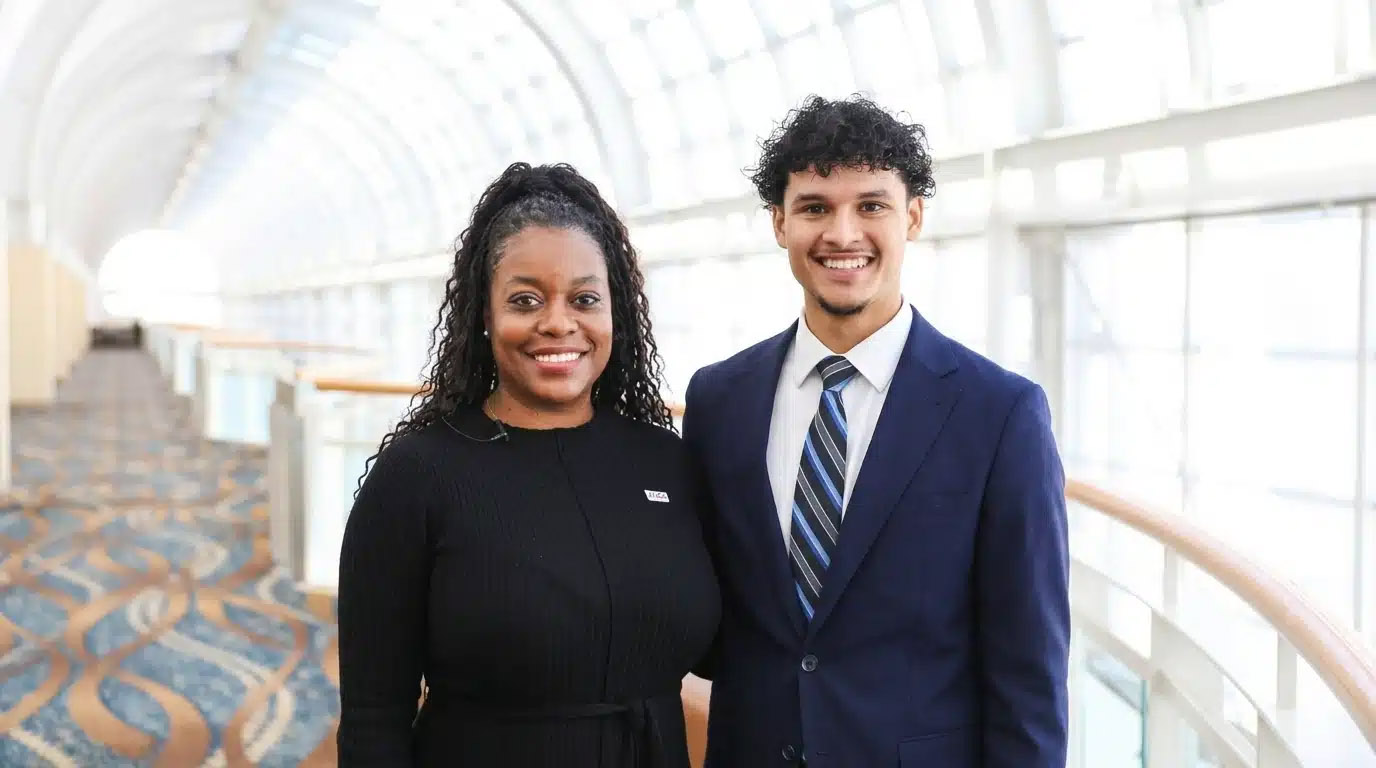
Ms. Bogar and Alberto co-led a workshop together called, Through the Alumni Lens: Strengthening JAG Programs Beyond Graduation.
The session invited participants to see life after graduation through students’ eyes and explore hands-on strategies to engage, mentor and empower JAG alumni.
For Ms. Bogar, it was an opportunity to present alongside a former student who was actualizing his potential.
For Alberto, it was a chance to give back to the program that helped him find his direction.
“Without JAG, I wouldn’t be in college. I don’t know where I’d be. But because of this program, I’m an accounting intern. I’m on the dean’s list for my university,” he says. “If I can help one person pursue their dreams, that’s enough for me,” he says. “It’s paying it forward.”
___________________________________________________
1. www.sciencedirect.com/science/article/pii/S0190740926000617
2. www.attendanceworks.org/reducing-elevated-school-levels-of-chronic-absence-urgent-and-still-within-our-reach/
3. https://www.randstad.com/genz/
4. www.insidehighered.com/news/students/retention/2025/10/02/contextualizing-completion-gaps-first-gen-students